
Introducing Role-Based Access Control (RBAC) in Apaya

Give every team member the right level of control, without risking your payment infrastructure
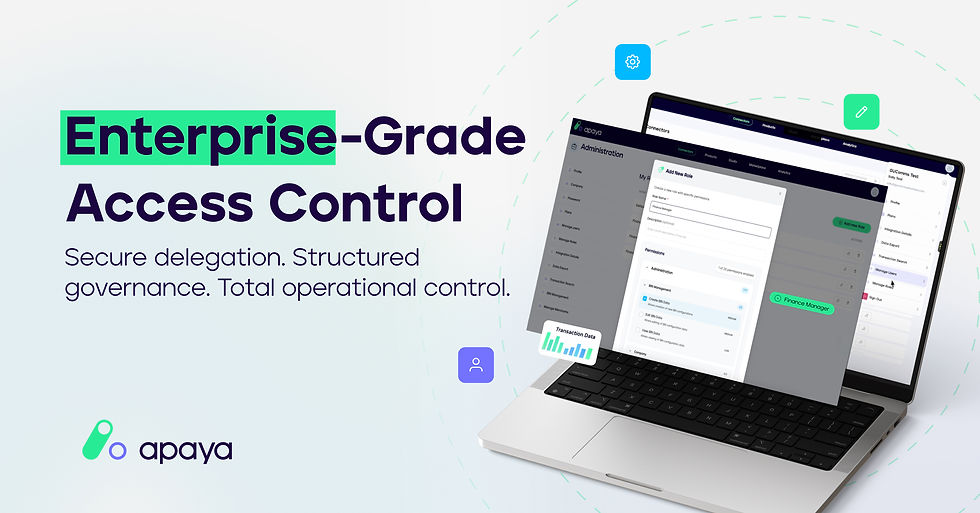
Payments don’t live in one department anymore. Finance reconciles. Product experiments with checkout logic. Operations monitors failures. Engineering integrates providers. We know all about the cross collaboration, and we get the silos.
Until now, most payment stacks forced a binary choice: everyone has access, or no one does.
Today we’re changing that.
We have launched Role-Based Access Control (RBAC) inside the Apaya portal, a new feature that lets you safely collaborate across teams while keeping full governance and traceability over your payment infrastructure.
Why This Matters
As companies scale across markets, payment orchestration stops being a technical tool and becomes an operational system.
You need multiple teams working inside it, but not all with the same authority. You also need to track and trace changes.
Typical risks we see from merchants:
A support agent accidentally changes routing
Finance cannot export transaction data
Product waits on engineering for simple configuration updates
Compliance teams lack audit visibility
RBAC solves this by aligning payment permissions with real business roles while ensuring full permissions transparency.
What You Can Now Do
Assign access by responsibility, not by workaround
You can create users and give them only the permissions they require.
Examples:
Finance → export transactions
Operations → view performance analytics
Product → modify payment flows
Engineering → manage connectors
Admin → full control
Permissions combine across roles, so users gain capabilities relevant to their function without becoming super-admins. There is full permission transparency as every action is logged and every change is traceable.
Immediate, auditable changes
Role updates apply instantly and are recorded in the audit trail, including:
Who made the change
What changed
When it happened
This helps internal governance and external compliance reviews.
Protect high-risk actions
Certain actions can materially impact revenue, deleting flows, modifying connectors, and exporting data.
You can now restrict these to specific roles following least-privilege security practices.
How Role-Based Access Control Fits Into Apaya’s Platform

Apaya has always focused on giving business teams operational control over payments, not just developers.
Our orchestration platform already lets companies:
Connect multiple PSPs
Optimise routing
Manage workflows without code
RBAC extends that philosophy: Empower teams, without sacrificing control.
It ensures collaboration scales safely as your organisation grows.
An Example
A multi-market eCommerce merchant operating across the UAE and KSA typically structures access like this:
Team | Access |
Finance | View transactions + export reports |
Product | Modify checkout logic |
Payments Ops | Monitor failures + retry flows |
Engineering | Manage integrations |
Compliance | Audit visibility only |
Admin | Full access |
Now this can be configured natively in Apaya, no internal workarounds required and all actions are logged, and changes are traceable.
Built for Growing Payment Teams
As payment orchestration adoption increases, governance becomes as important as optimisation.
RBAC ensures:
Faster collaboration
Fewer operational risks
Stronger compliance posture
Clearer accountability
And most importantly, it lets organisations scale without locking the platform behind engineering teams.
Available Now
RBAC is live in the Apaya portal. If you have any questions or need any support regarding this feature, please contact support@apaya.io.
Comments